Mantra & Co. - Advocate & Tax Consultant

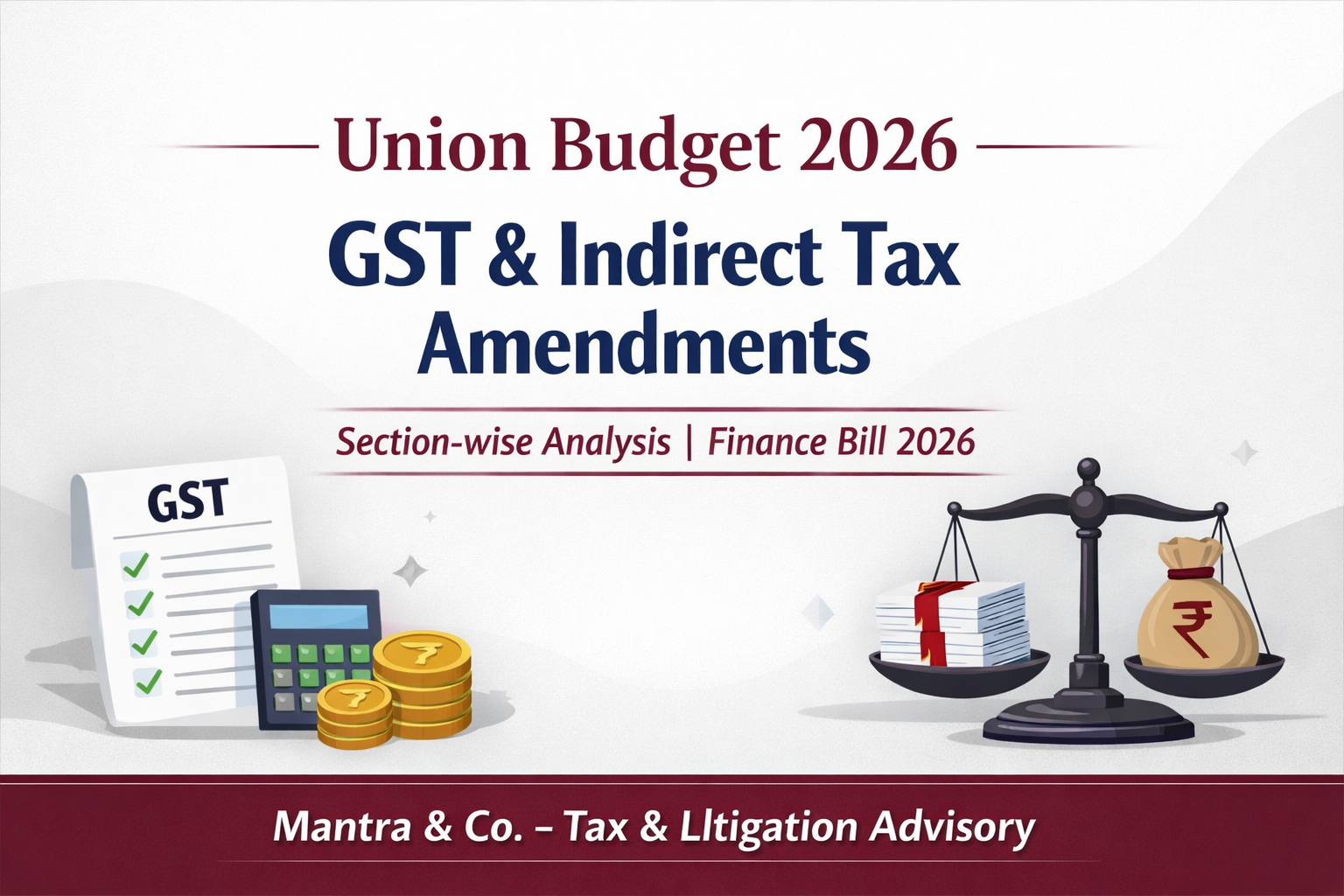
Union Budget 2026: GST & Indirect Tax Amendments – Section-wise Analysis

The Union Budget 2026 introduces a series of targeted amendments under the Goods and Services Tax (GST) framework through the Finance Bill, 2026. While no major changes have been made to GST rates, the budget focuses on strengthening valuation rules, improving refund mechanisms, providing clarity in appellate provisions, and addressing long-standing issues related to exports and intermediary services.
GST & Indirect Tax Amendments in Union Budget 2026
The GST amendments proposed in Union Budget 2026 primarily aim at resolving interpretational ambiguities, improving compliance efficiency, and strengthening dispute resolution mechanisms. Instead of introducing structural changes or rate revisions, the Government has focused on refining existing provisions relating to valuation, credit notes, refunds, appellate processes, and place of supply rules.
These amendments are expected to reduce litigation, improve cash flow for businesses, and provide long-awaited relief in specific areas such as exports and intermediary services. Taxpayers, professionals, and businesses must carefully evaluate these changes to ensure timely compliance and effective tax planning.
1. Post-Sale Discounts & Credit Notes under GST
Earlier Position
Prior to Union Budget 2026, the GST law permitted deduction of post-sale discounts from the value of taxable supply only when such discounts were agreed upon at or before the time of supply and were clearly linked to the relevant tax invoices. This position was derived from the combined reading of Section 15 of the CGST Act, 2017 and Rule 53 relating to credit notes.
In practice, discounts offered after the completion of supply—such as year-end incentives, volume-based discounts, or performance-linked rebates—were frequently disallowed during GST audits and assessments. Tax authorities often treated such discounts as inadmissible adjustments to taxable value, leading to valuation disputes and demand notices.
Amendment Proposed in Budget 2026
The Finance Bill, 2026 proposes to align the provisions relating to credit notes under Section 34 of the CGST Act with the valuation provisions under Section 15. The amendment clarifies that post-sale discounts may be adjusted from the value of supply even in cases where there was no pre-existing agreement at the time of supply.
However, such adjustment is permitted only when a valid credit note is issued by the supplier and the recipient reverses the proportionate Input Tax Credit (ITC) attributable to such discount. This amendment removes the rigid requirement of a prior contractual agreement for post-sale discounts to be recognised under GST.
Practical Impact on Taxpayers
This amendment provides significant commercial flexibility to businesses that routinely offer post-sale discounts, particularly in sectors such as FMCG, manufacturing, trading, and distribution. Businesses can now structure incentive schemes without the risk of automatic valuation disallowance, provided GST compliance conditions are fulfilled.
At the same time, the amendment places responsibility on both supplier and recipient to ensure proper documentation and proportionate ITC reversal. Failure to comply with these conditions may still result in disputes during audit or scrutiny proceedings.
Effective Date
This amendment shall be effective from 1 April 2026, unless notified otherwise by the Government.
2. Alignment of Valuation Rules with Credit Note Provisions
Earlier Position
Before the amendments proposed in Union Budget 2026, the GST law contained valuation provisions under Section 15 of the CGST Act and credit note provisions under Section 34. However, the law did not expressly link these two sections, resulting in interpretational gaps.
Due to the absence of explicit alignment, tax authorities often questioned whether credit notes issued for post-supply adjustments could validly reduce the taxable value, even when GST had been correctly adjusted. This ambiguity frequently resulted in objections during audits, assessments, and refund proceedings.
Amendment Proposed in Budget 2026
The Finance Bill, 2026 clarifies and strengthens the linkage between Section 15 (valuation of taxable supply) and Section 34 (credit notes) of the CGST Act. By expressly aligning these provisions, the amendment confirms that value adjustments made through valid credit notes form part of the statutory valuation mechanism under GST.
This legislative clarification removes uncertainty regarding the legal treatment of post-supply price adjustments and reinforces the role of credit notes as a recognised tool for valuation correction.
Practical Impact on Taxpayers
The amendment enhances legal certainty for businesses issuing credit notes for post-supply adjustments. It limits the scope for discretionary interpretation by tax officers and reduces the risk of valuation-related disputes during scrutiny or audit proceedings.
For compliant taxpayers, this change improves confidence in structuring commercial transactions while ensuring that GST adjustments are supported by statutory provisions.
Effective Date
This amendment shall take effect from 1 April 2026, unless notified otherwise.
3. Refund of Accumulated ITC due to Inverted Duty Structure
Earlier Position
Under the GST regime, refund of accumulated Input Tax Credit (ITC) arising due to an inverted duty structure was permitted under Section 54 of the CGST Act, subject to prescribed conditions. However, in practice, such refund claims often faced delays due to procedural scrutiny and lack of clarity regarding provisional refund eligibility.
Tax authorities frequently undertook detailed verification before sanctioning refunds, resulting in prolonged processing timelines and blockage of working capital, particularly for manufacturing and trading businesses operating under an inverted duty structure.
Amendment Proposed in Budget 2026
The Finance Bill, 2026 extends the scope of the provisional refund mechanism to explicitly cover refund claims arising from an inverted duty structure. This amendment enables eligible taxpayers to receive provisional refunds pending final verification, subject to statutory safeguards.
By formally recognising inverted duty structure refunds within the provisional refund framework, the amendment seeks to address long-standing concerns regarding delays in refund processing.
Practical Impact on Taxpayers
This amendment is expected to provide significant relief to businesses affected by inverted duty structures by improving liquidity and reducing working capital constraints. Faster access to refunds will particularly benefit manufacturers and MSMEs operating with thin margins.
At the same time, taxpayers must ensure strict compliance with refund conditions, documentation requirements, and accurate return filing to avoid rejection or recovery at the final verification stage.
Effective Date
This amendment shall be applicable from 1 April 2026, unless notified otherwise.
4. IGST Refund on Export of Goods – Threshold Removed
Earlier Position
Under the GST framework, exporters were entitled to claim refund of Integrated Goods and Services Tax (IGST) paid on export of goods under Section 54 of the CGST Act read with the IGST Act. However, the refund mechanism was subject to prescribed thresholds and procedural conditions.
In practice, exporters—particularly small and medium exporters—often experienced delays or restrictions in refund processing due to value-based limits and system validations, resulting in working capital blockage and compliance challenges.
Amendment Proposed in Budget 2026
The Finance Bill, 2026 removes the threshold limit for sanctioning refund of IGST paid on export of goods. This amendment allows exporters to claim refund of IGST without being constrained by value-based thresholds previously prescribed under the law.
The change reflects the Government’s intent to simplify the refund mechanism for exporters and ensure smoother flow of export-related tax refunds.
Practical Impact on Taxpayers
Removal of the refund threshold is expected to significantly improve cash flow for exporters by enabling faster and unrestricted refund of IGST paid on exports. This is particularly beneficial for MSME exporters who rely heavily on timely refunds to sustain operations.
The amendment also reduces procedural hurdles and enhances predictability in the export refund process, thereby improving ease of doing business for export-oriented entities.
Effective Date
This amendment shall take effect from 1 April 2026, unless notified otherwise.
5. GST Appellate Tribunal & Transitional Appeal Provisions
Earlier Position
The GST law envisaged the establishment of a Goods and Services Tax Appellate Tribunal (GSTAT) as the appellate authority for disputes under the CGST Act. However, due to prolonged delays in the constitution and operationalisation of the Tribunal, taxpayers faced significant challenges in pursuing second-stage appeals.
In the absence of a functional Tribunal, litigants were often left without an effective appellate remedy, resulting in increased writ petitions before High Courts and prolonged litigation.
Amendment Proposed in Budget 2026
The Finance Bill, 2026 introduces a transitional mechanism to address the non-operational status of the GST Appellate Tribunal. It empowers the Central Government to notify an existing authority or tribunal to hear appeals under Section 101B of the CGST Act until the GST Appellate Tribunal becomes fully functional.
Additionally, the amendment provides that certain procedural provisions under Section 101A shall not apply during the transitional period, ensuring continuity of appellate proceedings.
Practical Impact on Taxpayers
This amendment provides much-needed clarity and relief to taxpayers involved in GST litigation by ensuring that appellate remedies remain available despite delays in the constitution of the GST Appellate Tribunal. It helps prevent procedural deadlocks and reduces reliance on writ jurisdiction for dispute resolution.
For businesses and professionals, this change brings greater certainty in planning litigation strategy and managing pending GST disputes.
Effective Date
These provisions shall come into force from 1 April 2026, unless notified otherwise.
6. Place of Supply for Intermediary Services – Key Change
Earlier Position
Under the IGST framework, intermediary services were governed by a special place of supply rule under Section 13(8)(b) of the IGST Act, 2017. As per this provision, the place of supply for intermediary services was deemed to be the location of the supplier.
This special rule resulted in GST being levied on intermediary services even when such services were provided to foreign clients, leading to disputes on taxability of export-oriented services. The provision was widely litigated and considered inconsistent with general place of supply principles.
Amendment Proposed in Budget 2026
The Finance Bill, 2026 omits Section 13(8)(b) of the IGST Act, thereby removing the special place of supply rule applicable to intermediary services. Consequently, intermediary services will now be governed by the general place of supply rule under Section 13(2) of the IGST Act.
This amendment eliminates the deeming fiction that treated intermediary services as supplied within India solely based on the supplier’s location.
Practical Impact on Taxpayers
The removal of the special place of supply provision provides significant relief to service exporters and intermediaries dealing with overseas clients. It reduces the risk of double taxation and aligns the GST framework with internationally accepted destination-based taxation principles.
The amendment is expected to substantially reduce litigation related to intermediary services and improve competitiveness of Indian service providers in global markets.
Effective Date
This amendment shall be effective from 1 April 2026, unless notified otherwise.
Conclusion: GST Impact of Union Budget 2026
The GST amendments introduced through Union Budget 2026 reflect a clear shift towards legal clarity, procedural efficiency, and reduction of long-standing disputes. Instead of altering tax rates, the Government has focused on refining valuation rules, strengthening refund mechanisms, ensuring continuity in appellate remedies, and addressing critical issues affecting exporters and intermediary services.
These changes indicate a maturing GST framework where compliance certainty and dispute resolution are prioritised over frequent structural changes. For businesses and professionals, the amendments reinforce the importance of accurate documentation, timely compliance, and proactive assessment of GST positions.
Practical Takeaways for Taxpayers and Businesses
- Businesses offering post-sale discounts should review credit note and ITC reversal processes to align with the amended valuation provisions.
- Taxpayers operating under inverted duty structures should evaluate eligibility for faster refunds and ensure compliance readiness for provisional refund claims.
- Exporters should reassess refund strategies in light of the removal of IGST refund thresholds.
- Intermediary service providers dealing with overseas clients must revisit place of supply positions to determine export eligibility under the revised law.
- Taxpayers involved in GST disputes should closely track notifications relating to appellate authorities under the transitional tribunal framework.
Disclaimer: This article is for informational purposes only and does not constitute legal or tax advice. The views expressed are based on the current understanding of law and portal functionality as on the date of publication. Readers are advised to seek professional advice before taking any action.
If you have any general query or wish to understand the subject better, you may share your question in the comments below.
For insights into GST compliance issues arising from portal automation, you may also read our article on GST compliance updates and portal-driven changes.