Mantra & Co. - Advocate & Tax Consultant

GST Rule 14A Registration and Withdrawal Facility – Latest Update (21-02-2026)

Introduction
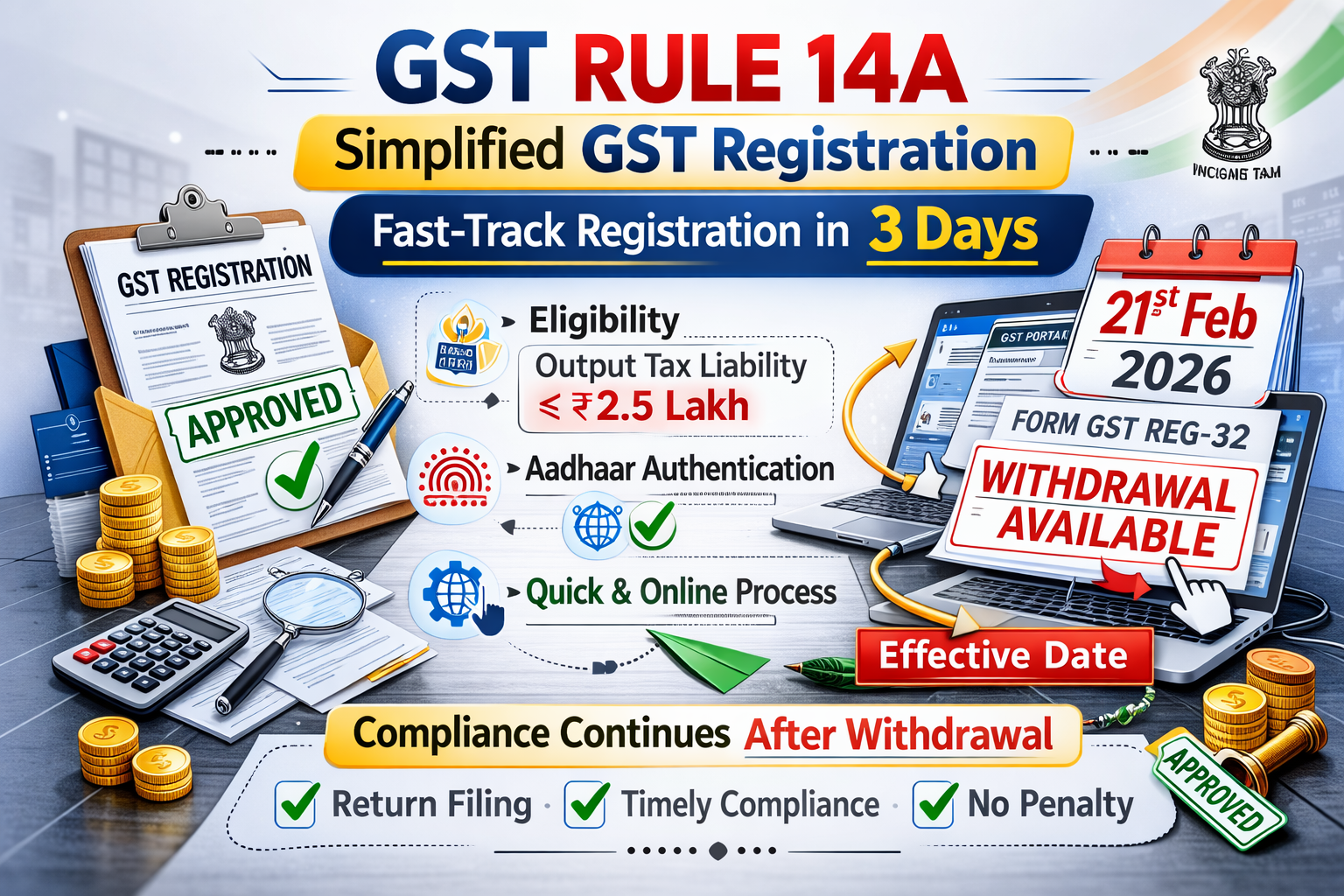
GST Rule 14A, introduced with effect from 1 November 2025, provides a simplified registration mechanism for eligible taxpayers opting for fast-track GST registration subject to specified conditions.
While the scheme enables quicker registration, taxpayers must comply with output tax liability thresholds and other conditions prescribed under the law.
On 21 February 2026, GSTN enabled an online facility for eligible taxpayers to withdraw from Rule 14A by filing Form GST REG-32 on the GST Portal
GSTN – Facility for Withdrawal …
This article explains:
- What Rule 14A registration is
- Who is eligible
- When withdrawal becomes necessary
- How to apply for withdrawal on the GST Portal
- Key pre-conditions and timelines
1. What is GST Rule 14A?
Rule 14A provides an optional simplified GST registration route for eligible taxpayers.
Key features include:
- Fast-track electronic registration (subject to eligibility)
- Aadhaar authentication requirement
- Monthly output tax liability threshold condition (₹ 2.5 lakh in respect of supplies made to registered persons)
- Continued compliance under normal GST provisions
It is important to note that Rule 14A does not dilute compliance obligations; it only simplifies the registration process for eligible persons.
2. When is Withdrawal from Rule 14A Required?
Withdrawal may become necessary in situations such as:
- Output tax liability exceeding ₹ 2.5 lakh limit
- Change in business circumstances
- Voluntary shift to normal registration category
- Non-fulfilment of Rule 14A eligibility conditions
In such cases, the taxpayer must formally opt out through the prescribed process.
3. Latest Update – Withdrawal Facility Enabled (21-02-2026)
GSTN has enabled an online facility for eligible taxpayers to apply for withdrawal from the option availed under Rule 14A by filing Form GST REG-32 on the GST Portal
GSTN – Facility for Withdrawal …
This facility is now available under:
Services → Registration → Application for Withdrawal from Rule 14A
The option is visible only for active taxpayers registered under Rule 14A
GSTN – Facility for Withdrawal …
4. Who Can Apply for Withdrawal?
Only:
- Active taxpayers
- Registered under Rule 14A
are eligible to apply for opt-out
GSTN – Facility for Withdrawal …
5. Key Pre-Conditions Before Filing Form GST REG-32
The portal will not allow filing of REG-32 unless the following return filing conditions are satisfied
GSTN – Facility for Withdrawal …
If filed before 1 April 2026:
- Returns for a minimum period of three months must be furnished.
If filed on or after 1 April 2026:
- Returns for at least one tax period must be furnished.
Additionally:
- All returns due from the effective date of registration till the date of filing REG-32 must be filed
GSTN – Facility for Withdrawal …
6. Aadhaar Authentication Requirement
Aadhaar authentication is mandatory for:
- Primary Authorised Signatory (mandatory)
- At least one Promoter/Partner (where applicable)
GSTN – Facility for Withdrawal …
Depending on data analysis, authentication may be:
- OTP-based
- Biometric-based
GSTN – Facility for Withdrawal …
ARN is generated only after successful authentication
GSTN – Facility for Withdrawal …
7. Important Timelines
As per GSTN advisory
GSTN – Facility for Withdrawal …
- Draft application must be submitted within 15 days of creation.
- Aadhaar/Biometric authentication must be completed within 15 days from submission.
- If authentication is not completed within prescribed time, ARN will not be generated.
8. Restrictions During Processing
While REG-32 application is pending:
- Core amendment cannot be filed
- Non-core amendment cannot be filed
- Self-cancellation application cannot be filed
GSTN – Facility for Withdrawal … Taxpayers must plan accordingly before initiating withdrawal.
9. Post-Approval (Form GST REG-33)
After sanction of withdrawal order in Form GST REG-33:
The taxpayer shall be able to furnish output tax liability exceeding ₹ 2.5 lakh from the first day of the succeeding month in which the order is issued
GSTN – Facility for Withdrawal … This effectively shifts the taxpayer into the normal registration compliance framework.
Conclusion
GST Rule 14A offers a simplified registration mechanism, but it comes with specific compliance conditions.
The newly enabled withdrawal facility (effective 21-02-2026) provides a structured method for taxpayers to opt out where eligibility conditions change.
Taxpayers registered under Rule 14A should carefully review:
- Output tax liability thresholds
- Return filing compliance
- Aadhaar authentication requirements
- Portal restrictions during processing
Timely action and procedural compliance are essential to avoid system disruptions.
Disclaimer: This article is for informational purposes only and does not constitute legal or tax advice. The views expressed are based on the current understanding of law and portal functionality as on the date of publication. Readers are advised to seek professional advice before taking any action.
If you have any general queries or wish to understand the subject better, you may share your question in the comments below.
For insights into GST compliance issues arising from portal automation, you may also read our article on GST Rule 14A Optional Category – Portal Blocking Issue Explained