Mantra & Co. - Advocate & Tax Consultant

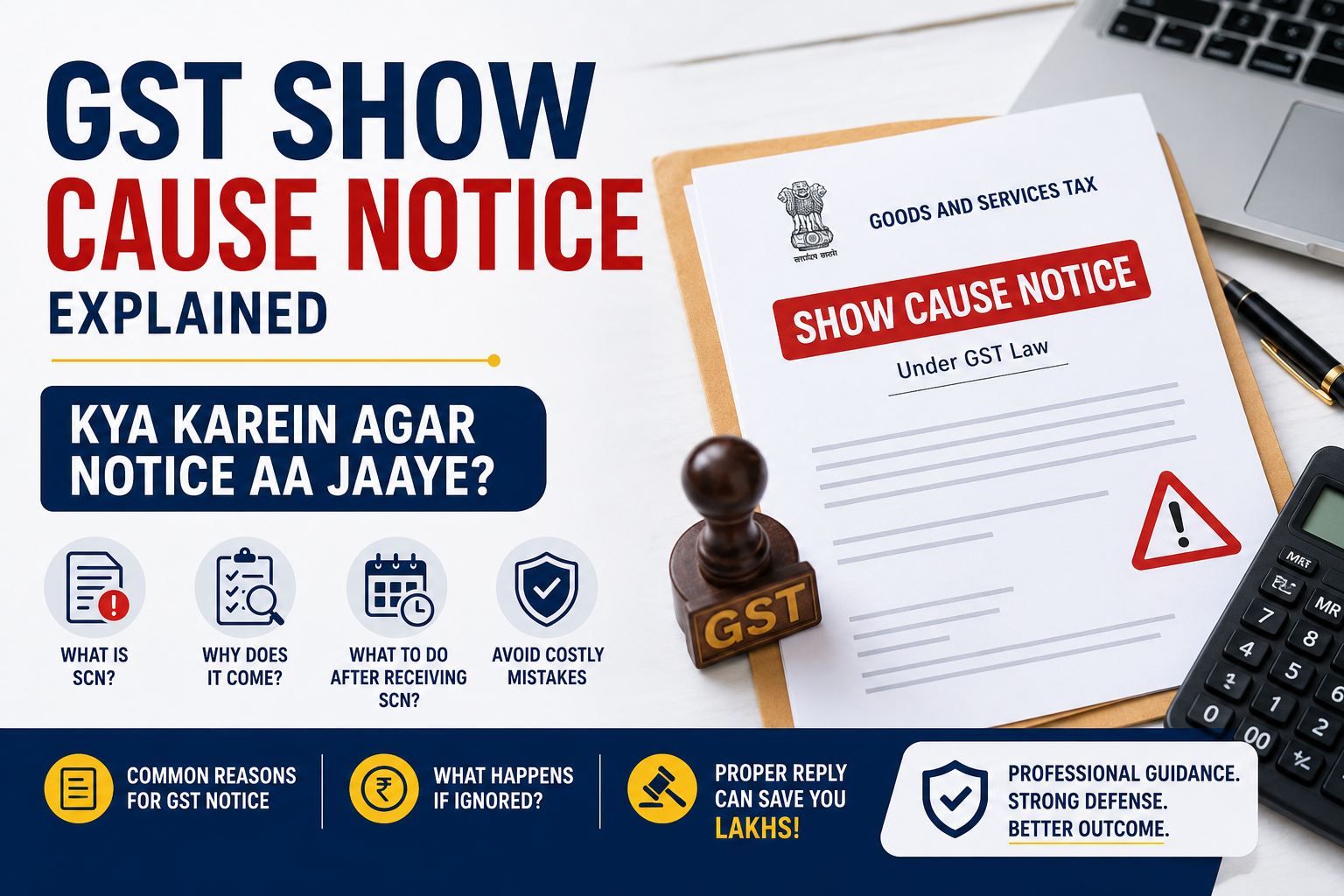
GST Show Cause Notice (SCN): What It Means and What to Do After Receiving One

Receiving a GST Show Cause Notice (SCN) can be stressful, especially when the notice mentions tax liability, Input Tax Credit (ITC), interest, penalty or other compliance issues.
But the first thing a taxpayer should understand is simple:
A GST Show Cause Notice is not, by itself, a final determination of liability.
A show cause notice generally gives the taxpayer an opportunity to understand the allegations or proposed action and present their explanation, documents and submissions before the matter is decided in accordance with the applicable law and procedure.
However, an SCN should never be casually ignored.
The right response depends on the type of notice, the period involved, the provisions cited, the facts of the transaction and the supporting records available with the taxpayer.
In this article, we explain what a GST Show Cause Notice means, why it may be issued, common reasons for GST notices, what happens if a notice is not properly addressed, and how businesses should approach an SCN response.
Disclaimer: This article is for general educational and informational purposes only. GST provisions, procedures, forms, timelines and consequences may vary depending on the financial year, type of notice and facts of the case. This article should not be treated as legal or tax advice for any specific taxpayer.
Watch the Complete Video Explanation
or a better understanding of this topic, you can also refer to the detailed video explanation where the concepts are discussed step-by-step with practical insights and real-world context.
What Is a GST Show Cause Notice?
A GST Show Cause Notice (SCN) is a formal communication through which the tax authorities may require a registered person or other relevant person to explain why a proposed action should not be taken under the applicable GST provisions.
Depending on the circumstances, a notice may relate to issues such as:
- Tax not paid or short paid
- Erroneous refund
- Input Tax Credit wrongly availed or utilised
- Differences in GST returns
- Classification or tax-rate issues
- Documentation concerns
- Other GST compliance matters
The exact meaning of the notice depends on the section mentioned, period involved and allegations or discrepancies stated in the communication.
Therefore, taxpayers should avoid treating every GST notice as the same.
Is a GST Show Cause Notice the Same as a Final Demand Order?
No.
A Show Cause Notice and a final adjudication/order are different stages of proceedings.
An SCN essentially gives the taxpayer an opportunity to show cause or explain why the proposed liability or action should not be confirmed, subject to the applicable provisions.
After considering the taxpayer’s representation and the applicable procedure, the proper officer may determine the matter in accordance with law.
This is why the SCN stage can be important.
A taxpayer may have an opportunity to:
- Explain the actual facts
- Identify an incorrect assumption
- Reconcile a mismatch
- Submit supporting documents
- Explain the tax treatment
- Raise applicable legal or factual grounds
The response should therefore be specific, factual and properly supported, rather than a generic statement.
Which GST Sections Are Relevant to Show Cause Notices?
The applicable section depends on the financial year and nature of the issue.
For periods up to FY 2023-24, Sections 73 and 74 of the CGST Act are relevant for determination of tax not paid or short paid, erroneous refunds, or ITC wrongly availed or utilised, with Section 74 dealing with cases involving fraud, wilful misstatement or suppression of facts as specified by law.
For FY 2024-25 onwards, Section 74A was introduced for determination of tax not paid or short paid, erroneous refunds, or ITC wrongly availed or utilised. The provision also deals with the applicable treatment where fraud, wilful misstatement or suppression of facts is involved.
Therefore, when you receive a GST SCN, do not rely only on the notice title. Check the section cited, relevant financial year, nature of allegation and the specific grounds mentioned.
Why Do Businesses Receive GST Show Cause Notices?
There is no single reason for an SCN.
However, certain areas commonly require attention during GST compliance and departmental verification.
1. GSTR-1 and GSTR-3B Differences
One common area is a difference between outward supplies reported in GSTR-1 and the tax liability discharged through GSTR-3B.
Differences may occur because of:
- Reporting errors
- Amendments
- Timing differences
- Credit/debit notes
- Incorrect classification
- Other reconciliation issues
A difference should therefore be reconciled before assuming that it represents tax evasion or intentional non-payment.
2. Input Tax Credit (ITC) Differences
ITC-related discrepancies can also result in communications or proceedings.
For example, differences may arise between the ITC claimed and information reflected through supplier-reported data or other records.
However, businesses should investigate the reason for the difference before concluding that the ITC is automatically ineligible.
Relevant records can include:
- Purchase invoices
- GSTR-2B
- Supplier details
- Books of accounts
- Payment records
- Goods receipt records
- E-way bills, where applicable
The eligibility of ITC ultimately depends on the applicable statutory conditions and facts of the transaction.
3. Incorrect GST Rate or Classification
GST rates depend on the nature and classification of goods or services and the applicable notifications and provisions.
Applying an incorrect rate can potentially result in a tax difference.
This is particularly important where a product or service has:
- Multiple classifications
- Specific rate conditions
- Exemptions
- Special notifications
- Different rates based on particular conditions
Businesses should therefore verify the applicable classification and rate rather than relying solely on historical billing practices.
For official GST rate information, taxpayers should refer to the applicable government notifications and resources.
4. Return Filing and Tax Payment Issues
GST compliance involves timely filing of applicable returns and payment of tax.
Issues involving non-filing, delayed filing, unpaid self-assessed tax or other compliance defaults may lead to statutory consequences depending on the circumstances.
However, the consequences of delayed filing are not necessarily identical in every situation.
For example, CBIC has clarified that Section 73(11) is not generally invoked merely for delayed filing of GSTR-3B where the tax along with applicable interest has already been paid, although other consequences may apply depending on the facts.
This is why the actual facts and applicable provision matter when responding to a GST notice.
5. Suspicious or Unsupported Invoicing
GST authorities may examine transactions where there are concerns regarding the genuineness of supplies or supporting documentation.
Examples could include situations involving:
- Invoices without corresponding supplies
- Inadequate transaction records
- Unusual transaction patterns
- Questionable vendor/customer details
- Inconsistent movement of goods
Businesses should maintain proper documentation demonstrating the commercial substance and supporting records of their transactions.
6. Vendor and ITC Mismatches
A business may sometimes face an ITC-related issue because of differences in supplier reporting.
However, a mismatch does not automatically establish that the recipient has wrongly claimed ITC.
The business should examine:
- Purchase invoice
- Supplier GSTIN
- GSTR-2B
- Books of accounts
- Payment records
- Receipt of goods/services
- Other applicable ITC conditions
The response should address the actual reason for the difference, supported by relevant records.
7. E-Way Bill and Invoice Differences
Where movement of goods is involved, e-way bill information may be relevant to the transaction.
Differences between:
- Invoice details
- E-way bill details
- Quantity
- Value
- Vehicle details
- Date
- Place of supply or movement
may require clarification depending on the circumstances.
A business should therefore retain appropriate logistics and transaction records.
8. GST Turnover and Other Financial Records
Businesses may also need to reconcile GST turnover with information appearing in their books and other statutory records.
A difference does not automatically mean that tax has been concealed.
There can be legitimate reasons for differences, including:
- Exempt supplies
- Non-GST supplies
- Timing differences
- Credit/debit notes
- Accounting adjustments
- Different reporting requirements
The important part is being able to explain and document the difference properly.
What Happens If You Ignore a GST Show Cause Notice?
Ignoring an SCN is generally not a good compliance strategy.
The exact consequences depend on the type of proceedings and applicable provisions.
Where the taxpayer does not respond appropriately, the matter may proceed based on the applicable statutory process and information available to the authorities.
Depending on the case, this can potentially result in:
- Determination of tax liability
- Interest consequences
- Penalty, where applicable
- Further recovery proceedings
- Other statutory consequences
However, these consequences are not automatic merely because an SCN has been issued.
The outcome depends on the facts, applicable section, evidence, submissions and the order ultimately passed.
Can GST Authorities Recover Tax After an SCN?
Potentially, yes — where a tax liability is ultimately determined under the applicable law.
For example, the CGST framework provides mechanisms for determination of tax, interest and applicable penalty in relevant cases. Sections 73 and 74 contain specific provisions for periods to which they apply, while Section 74A applies to relevant periods from FY 2024-25 onwards.
The important point is:
An SCN is not the same thing as a final demand.
The taxpayer’s response and the subsequent proceedings can be important in determining the final outcome.
What Should You Do After Receiving a GST Show Cause Notice?
If your business receives an SCN, avoid immediately sending a generic response.
Instead, follow a structured approach.
Step 1: Read the Entire Notice
Step 2: Understand the Actual Allegation
Ask:
What exactly does the Department say is wrong?
Is it:
- GSTR-1 vs GSTR-3B difference?
- ITC mismatch?
- Incorrect tax rate?
- Non-payment of tax?
- Erroneous refund?
- Documentation issue?
- Classification issue?
- Supplier-related discrepancy?
Understanding the exact issue is the foundation of a proper response.
Step 3: Reconcile Your Records
Compare the notice allegations with your:
- GST returns
- Sales register
- Purchase register
- General ledger
- Tax invoices
- Credit/debit notes
- GSTR-2B
- E-way bills
- Bank statements
- Vendor records
- Other relevant documents
The objective is to determine whether the discrepancy is genuine, explainable or actually requires correction.
Step 4: Prepare Supporting Documents
A strong response should be supported by appropriate evidence.
Depending on the issue, this may include:
- Tax invoices
- Purchase invoices
- Sales register
- Purchase register
- E-way bills
- GSTR-1
- GSTR-3B
- GSTR-2B
- Ledger extracts
- Bank statements
- Agreements
- Payment records
- Reconciliation statements
- Other relevant documents
More documents do not automatically mean a better reply. The documents should be relevant to the specific allegation raised
Step 5: Prepare a Fact-Based Reply
A GST notice reply should generally be:
Clear + factual + documented + legally reasoned
A useful response should address the allegations point-by-point rather than simply stating:
“The notice is incorrect.”
For example, if the Department alleges an ITC mismatch, the response should explain the reconciliation and provide relevant supporting evidence and applicable legal grounds.
Where appropriate, the reply may also refer to relevant provisions, notifications, circulars or judicial decisions.
Step 6: Check the Applicable Deadline
The response timeline is important.
The exact period available for responding depends on the specific notice and applicable provision.
Therefore, do not assume that every GST notice has the same response deadline.
Always follow the deadline specified in the communication and applicable procedure.
If a hearing is provided or required, that should also be dealt with appropriately.
Step 7: Consider Professional Assistance
GST notices can involve complicated questions relating to:
- ITC eligibility
- Taxability
- Classification
- Rate of tax
- Reconciliation
- Procedural compliance
- Interest
- Penalty
- Statutory interpretation
Where the amount involved is significant or the legal issue is complex, professional assistance may be appropriate.
A professional review can help determine whether the issue is:
a genuine tax liability, a reconciliation difference, a documentation issue, or a matter requiring a legal defence.
For businesses looking for support with GST compliance and tax-related matters, explore our GST Services and related professional services.
Common Mistakes Businesses Make While Replying to GST Notices
1. Ignoring the Notice
This is one of the biggest mistakes.
Even when the taxpayer believes the notice is incorrect, the appropriate response should generally be to address the allegations through the prescribed process.
2. Missing the Deadline
A taxpayer should not wait until the last moment to start collecting documents.
As soon as the notice is received, the deadline should be noted and the preparation process should begin.
3. Sending a Generic Copy-Paste Reply
Every GST notice has its own facts.
A generic template may fail to address the actual allegations.
The response should be prepared according to the specific transaction, period, section and evidence involved.
4. Providing Incomplete Documents
Submitting only a few documents without connecting them to the issue raised can make the explanation difficult to evaluate.
Supporting documents should be relevant and properly referenced.
5. Giving Incorrect or Unsupported Facts
Never provide information simply because it appears convenient.
Statements made in a reply should be consistent with the taxpayer’s books, GST returns and supporting records.
6. Ignoring Legal Provisions
A response should not necessarily be limited to factual explanations.
Where the issue involves interpretation of GST law, applicable provisions, notifications, circulars or judicial precedents may need to be considered.
What Makes a Good GST Notice Reply?
A good GST SCN response is not necessarily the longest response.
It is one that directly addresses the allegations with facts, evidence and applicable legal reasoning.
A structured reply may include:
1. Background
Briefly explain the business and relevant transaction.
2. Issue Raised
Clearly identify the allegation made in the notice.
3. Facts
Explain what actually happened.
4. Reconciliation
Show how the figures in the notice compare with the taxpayer’s records.
5. Supporting Documents
Reference the documents supporting the explanation.
6. Legal Position
Where relevant, explain the applicable provisions, notifications, circulars or judicial principles.
7. Conclusion
State the taxpayer’s position and the relief or conclusion being requested.
This approach is generally more effective than submitting a long, unstructured explanation.
Don’t Panic, But Don’t Ignore a GST SCN
A GST Show Cause Notice is a serious compliance communication, but receiving one does not automatically mean that a final tax demand has been established.
The correct response depends on:
- The financial year
- Section mentioned
- Nature of the allegation
- Amount involved
- Supporting records
- Applicable GST provisions
- Facts of the transaction
The best approach is:
Read the notice → Understand the allegation → Reconcile the records → Collect evidence → Prepare a fact-based response → Submit it within the applicable timeline.
Do not respond emotionally and do not simply copy a generic template.
Where the matter involves significant tax exposure, ITC disputes, complex classification questions or allegations involving fraud or suppression, professional advice should be considered before submitting the response.