Mantra & Co. - Advocate & Tax Consultant

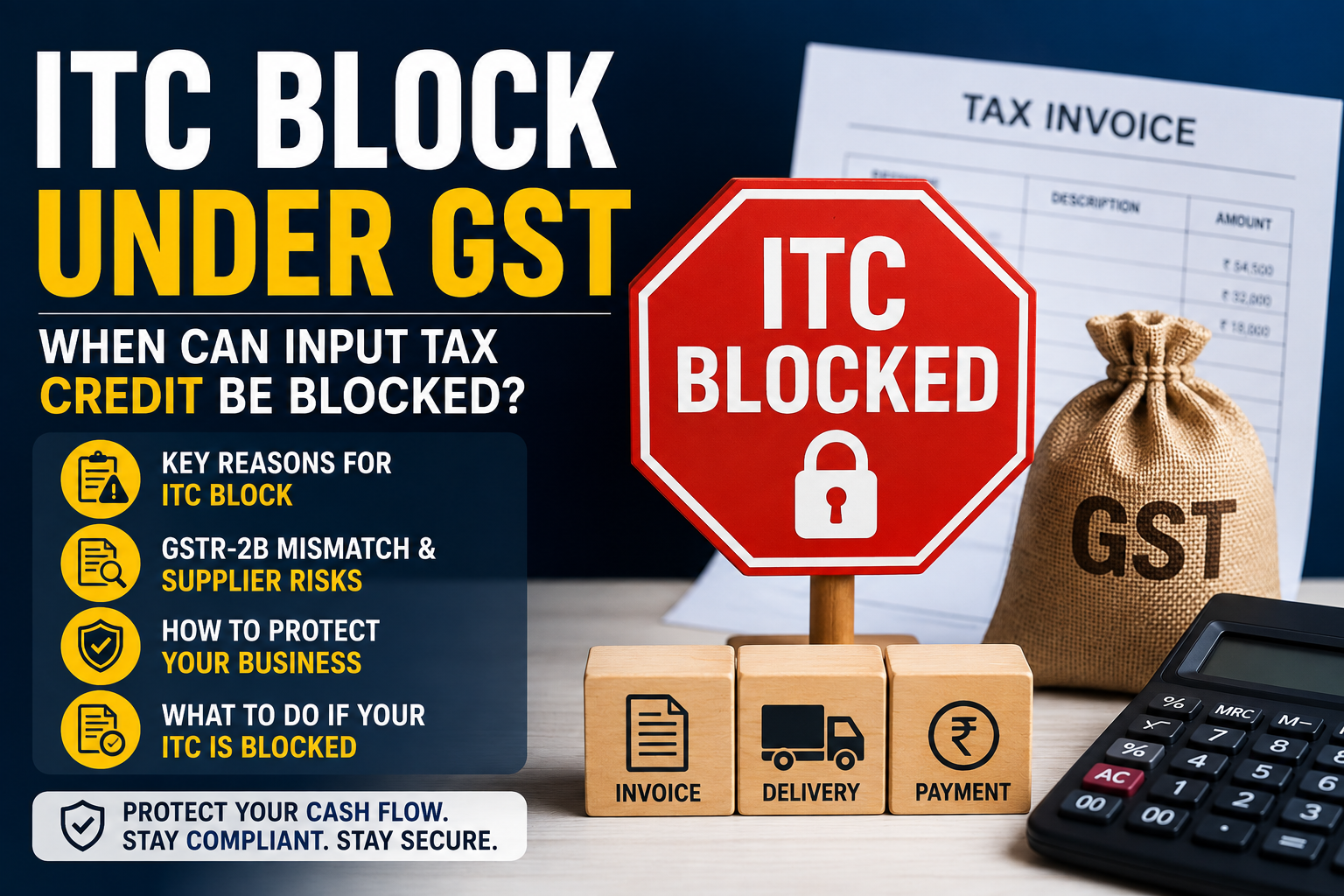
ITC Block Under GST: When Can Input Tax Credit Be Blocked?

Input Tax Credit (ITC) is an important part of GST compliance for many businesses. When eligible ITC is available, it can reduce the amount of output tax that needs to be paid through the electronic cash ledger.
But what happens when the credit becomes restricted or unavailable for utilization ?
For a business, an ITC-related restriction can have a direct impact on cash-flow planning. The business may have to arrange additional cash to discharge GST liability while the disputed or restricted credit remains unavailable for use.
This is why businesses should understand not only how to claim ITC, but also the circumstances in which ITC can become disputed, ineligible, reversed or subject to restrictions.
One important provision in this context is Rule 86A of the CGST Rules, 2017, which provides for restrictions on the use of amounts available in the electronic credit ledger in specified circumstances. CBIC’s guidelines state that the power may be exercised where the competent authority has reasons to believe that the credit has been fraudulently availed or is ineligible, subject to the rule and applicable safeguards.
In this article, we explain what ITC blocking means, when ITC can become restricted, common ITC risk areas, the role of GSTR-2B and supplier compliance, and what businesses should do when they face an ITC-related issue.
Disclaimer: This article is for general educational and informational purposes only. GST provisions, rules, notifications, circulars and departmental procedures may change and their applicability depends on the relevant period and facts of each case. This article should not be treated as legal or tax advice for a specific taxpayer.
Watch the Complete Video Explanation
for a better understanding of this topic, you can also refer to the detailed video explanation where the concepts are discussed step-by-step with practical insights and real-world context.
What Does “ITC Block” Mean Under GST?
In practical discussions, the term “ITC blocked” is often used when a taxpayer is unable to utilise credit available in the electronic credit ledger because its use has been restricted.
One specific statutory mechanism is Rule 86A of the CGST Rules.
Under Rule 86A, the Commissioner or an authorised officer not below the rank of Assistant Commissioner may, where there are reasons to believe that credit available in the electronic credit ledger has been fraudulently availed or is ineligible in the circumstances specified in the rule, restrict the debit of an amount equivalent to such credit.
This is different from simply having an ITC mismatch.
For example:
GSTR-2B mismatch → may require reconciliation or clarification
is not automatically the same as:
ITC formally restricted under Rule 86A.
Understanding this distinction is important before taking any action.
Why Is ITC Important for a Business?
Under the GST framework, eligible input tax credit can generally be used for payment of output tax, subject to the applicable conditions and utilisation rules.
For businesses with significant purchases, ITC can therefore form an important part of tax and cash-flow management.
Consider a simplified example.
A business has:
- Output GST liability: ₹5,00,000
- Eligible ITC: ₹3,00,000
Subject to applicable rules and utilisation restrictions, the business may use eligible ITC toward its output tax liability and pay the balance through the electronic cash ledger.
If a portion of the expected ITC cannot be utilised, the business may need to arrange additional cash. This is why ITC management is also a cash-flow management issue.
When Can ITC Become a Problem?
ITC does not become restricted for one single reason.
Businesses should distinguish between:
1. ITC that is legally ineligible
The underlying transaction may not satisfy the statutory conditions for claiming credit.
2. ITC that requires reversal
Credit may initially have been claimed but subsequently become subject to reversal under applicable provisions.
3. ITC that is disputed
The Department may question the eligibility or circumstances surrounding the credit.
4. ITC restricted from utilisation
In specified circumstances, such as those covered by Rule 86A, debit of credit from the electronic credit ledger may be restricted. These situations should not be treated as identical.
8 Major ITC Risk Areas Businesses Should Watch
| ITC Risk Area | What Can Happen | What Businesses Should Check | Key Action | |
|---|---|---|---|---|
| 1 | Supplier-Related Issues | Supplier may delay filing returns, report incorrect invoices, have registration-related issues, or provide information that does not reconcile with the recipient’s records. | Supplier GST details, invoice reporting, return status, purchase records and applicable ITC conditions. | Verify and reconcile supplier-related information before taking or continuing with the ITC claim. |
| 2 | GSTR-2B Differences | ITC may not match the purchase records due to delayed filing, period differences, incorrect invoice details, credit/debit notes, incorrect GSTIN or amendments. | Purchase register, invoices, GSTR-2B, supplier reporting and relevant tax periods. | Perform regular ITC reconciliation and investigate differences instead of automatically treating them as ineligible ITC. |
| 3 | Ineligible ITC Under GST Law | Certain credits may not qualify under the applicable provisions or may be subject to specific restrictions. | Nature and business use of goods/services, tax invoice requirements, payment/receipt conditions and blocked-credit provisions. | Check eligibility under the applicable GST provisions before claiming ITC. |
| 4 | Invoices Without Genuine Underlying Supplies | Transactions may attract scrutiny where there are concerns regarding the actual supply or supporting evidence. | Invoice, actual receipt of goods/services, vendor details, payment records, delivery evidence and books. | Maintain evidence demonstrating the genuine commercial substance of the transaction. |
| 5 | Circular Trading or Suspicious Transaction Patterns | Transactions involving multiple parties without clear commercial substance or adequate movement of goods may attract greater scrutiny. | Actual purchase/supply, commercial purpose, payment, delivery/receipt and transport documentation. | Ensure transactions reflect genuine business activity and maintain supporting evidence. |
| 6 | E-Way Bill & Invoice Differences | Differences in invoice and e-way bill details may require clarification, particularly where the inconsistency is significant. | Invoice, e-way bill, purchase register, goods receipt records, transport documents and accounting records. | Reconcile invoice and transportation information and maintain relevant supporting records. |
| 7 | Documentation Gaps | Lack of supporting records can make it difficult to substantiate an ITC claim during verification or proceedings. | Tax invoices, purchase orders, delivery challans, GRNs, e-way bills, transport documents, payment records and reconciliation statements. | Maintain complete and organised documentation supporting significant ITC claims. |
| 8 | ITC Under Departmental Examination | The Department may question specific ITC, request documents or, where applicable, restrict utilisation of credit under the relevant provisions. | Credit being questioned, financial year, applicable provision, notice, documents requested and any restriction on utilisation. | Understand the communication, gather evidence and respond through the applicable procedure within the prescribed timeline. |
Does a GSTR-2B Mismatch Automatically Block ITC?
No.
This is an important distinction.
A mismatch between the purchase register and GSTR-2B may indicate that the transaction needs to be investigated.
But it should not automatically be described as an ITC block under Rule 86A.
For example, a difference could arise because the supplier reported an invoice in a different period or made an amendment.
Therefore, businesses should follow a process:
Identify the mismatch → Find the reason → Verify the invoice → Check supplier reporting → Review applicable ITC conditions → Reconcile the records.
Only after understanding the reason should the business decide whether the credit needs to be claimed, deferred, reversed, or otherwise addressed.
What Is Rule 86A and How Does It Relate to Blocked ITC?
Rule 86A deals specifically with the conditions for use of amounts available in the electronic credit ledger.
Where the competent authority has reasons to believe that ITC has been fraudulently availed or is ineligible in the circumstances specified by the rule, the authority may restrict debit of an amount equivalent to such credit from the electronic credit ledger.
CBIC’s guidelines also explain that the power under Rule 86A should be exercised based on the prescribed conditions and that the reasons should be recorded in writing.
This is why the phrase “ITC blocked” should be used carefully. A simple mismatch, an ITC reversal and a Rule 86A restriction are different compliance situations.
What Happens to Business Cash Flow When ITC Cannot Be Used?
This is where the practical impact becomes important.
Suppose a business expects to utilise ₹2 lakh of eligible ITC against its GST liability.
If that credit cannot be utilised because of a restriction or because the credit is not currently available for use, the business may need to arrange additional cash to meet its tax payment obligations.
That can affect:
- Working capital
- Cash-flow planning
- Supplier payments
- Inventory purchases
- Short-term financing requirements
This is why businesses should treat ITC reconciliation as part of financial control, not merely as a monthly GST filing activity.
What Should You Do If Your ITC Is Restricted?
| Step | What to Do | What to Check / Collect | Key Objective |
|---|---|---|---|
| 1. Identify the Exact Issue | Determine why the ITC is unavailable or restricted. | GSTR-2B mismatch, ITC reversal, ineligible ITC, supplier issue, GST notice, Rule 86A restriction, portal issue or other discrepancy. | Understand the actual reason before taking corrective action. |
| 2. Check the Electronic Credit Ledger | Review your electronic credit ledger and relevant GST portal communications. | Credit ledger entries, portal notices/communications and relevant transaction details. | Confirm the status and identify any restriction or discrepancy. |
| 3. Reconcile the Relevant ITC | Match the affected ITC with your accounting and GST records. | Purchase register, tax invoices, GSTR-2B, GSTR-3B, books of accounts, supplier details and payment records. | Identify exactly which invoices or amounts are affected and why. |
| 4. Verify the Supplier | Review the supplier’s GST-related information and communicate with them where appropriate. | GSTIN, invoice reporting, relevant tax period, return filing, amendments and corrections. | Determine whether the issue originates from supplier reporting or another factor. |
| 5. Gather Supporting Evidence | Organise documents supporting the underlying transaction and ITC claim. | Tax invoice, purchase order, delivery proof, e-way bill, transport documents, payment proof, ledger, GSTR-2B, reconciliation statement and supplier correspondence. | Establish the actual facts and support your ITC position with relevant evidence. |
What If You Receive a GST Notice Regarding ITC?
If the Department has issued a notice questioning your ITC, treat the communication seriously.
First check:
What credit is being questioned?
Identify the exact invoice, supplier, tax period and amount.
Why is it being questioned?
Understand the allegation rather than immediately preparing a generic reply.
What provision has been cited?
The applicable section or rule can significantly affect the response.
What evidence do you have?
Gather documents supporting the transaction and eligibility.
What is the response deadline?
Make sure the reply is submitted within the applicable timeline.
A well-prepared response should address the specific allegations with facts, reconciliation and relevant legal reasoning.
For complex ITC disputes or departmental proceedings, professional assistance may be appropriate. You can explore GST Compliance and Advisory Services offered by Mantra & Co. for information about GST-related professional support.
How Can Businesses Reduce ITC Risk?
| ITC Risk-Control Measure | What Businesses Should Do | Key Benefit |
|---|---|---|
| Perform Monthly ITC Reconciliation | Compare purchase records with relevant GST data every month instead of waiting until year-end. | Helps identify mismatches and discrepancies at an early stage. |
| Maintain Strong Vendor Records | Verify GST registration details before onboarding important vendors and maintain appropriate commercial documentation. | Helps businesses assess vendor-related compliance risks. |
| Keep Complete Purchase Documentation | Maintain tax invoices along with relevant delivery, payment and accounting records. | Helps substantiate genuine purchases and ITC claims. |
| Review GSTR-2B Before Filing | Compare GSTR-2B with purchase records and consider the applicable ITC eligibility conditions before reporting ITC. | Helps identify differences before filing GST returns. |
| Reconcile Books With GST Returns | Regularly compare Books → Purchase Register → GSTR-2B → GSTR-3B and investigate differences. | Helps prevent discrepancies from accumulating over multiple periods. |
| Monitor E-Way Bills Where Applicable | Ensure invoice, e-way bill and relevant transportation information are properly documented and consistent. | Helps support the underlying movement of goods where applicable. |
| Don’t Claim ITC Only Because It Appears in a Statement | Treat GSTR-2B and other GST statements as reconciliation inputs, while separately checking whether the statutory ITC conditions are satisfied. | Helps avoid assuming that every reflected amount is automatically eligible for ITC. |
ITC Compliance Is More Than Just GSTR-2B
One of the biggest misconceptions is:
“Invoice GSTR-2B mein aa gaya, toh ITC guaranteed hai.”
That is not the correct way to look at ITC.
GSTR-2B can be an important reconciliation document, but ITC eligibility ultimately depends on the applicable provisions and conditions of GST law.
A proper ITC review should therefore combine:
GST data + Books + Invoice + Supply + Payment + Documentation + Legal eligibility
This broader approach can help businesses identify issues before they become larger disputes.
Key Takeaway
ITC is an important part of GST compliance and business cash-flow management, but it should not be treated as an unconditional entitlement.
Businesses should understand the difference between:
- ITC mismatch
- Ineligible ITC
- ITC reversal
- Disputed ITC
- Restriction on utilisation of credit under Rule 86A
A supplier issue or GSTR-2B mismatch may require investigation, but it should not automatically be described as a formal ITC block.
The practical approach is:
Reconcile → Verify → Document → Understand the applicable law → Respond appropriately.
If your business is facing an ITC dispute, GST notice or restriction on utilisation of credit, review the exact facts and communication before taking action.
Need Help With GST and ITC Compliance?
ITC-related issues can involve reconciliation, vendor compliance, documentation, GST returns and interpretation of applicable provisions.
If your business is facing an ITC discrepancy, GST notice or other compliance issue, the appropriate response depends on the specific facts and documents involved.
For information about GST Compliance and Advisory Services, visit Mantra & Co. – Advocate & Tax Consultant.