Mantra & Co. - Advocate & Tax Consultant

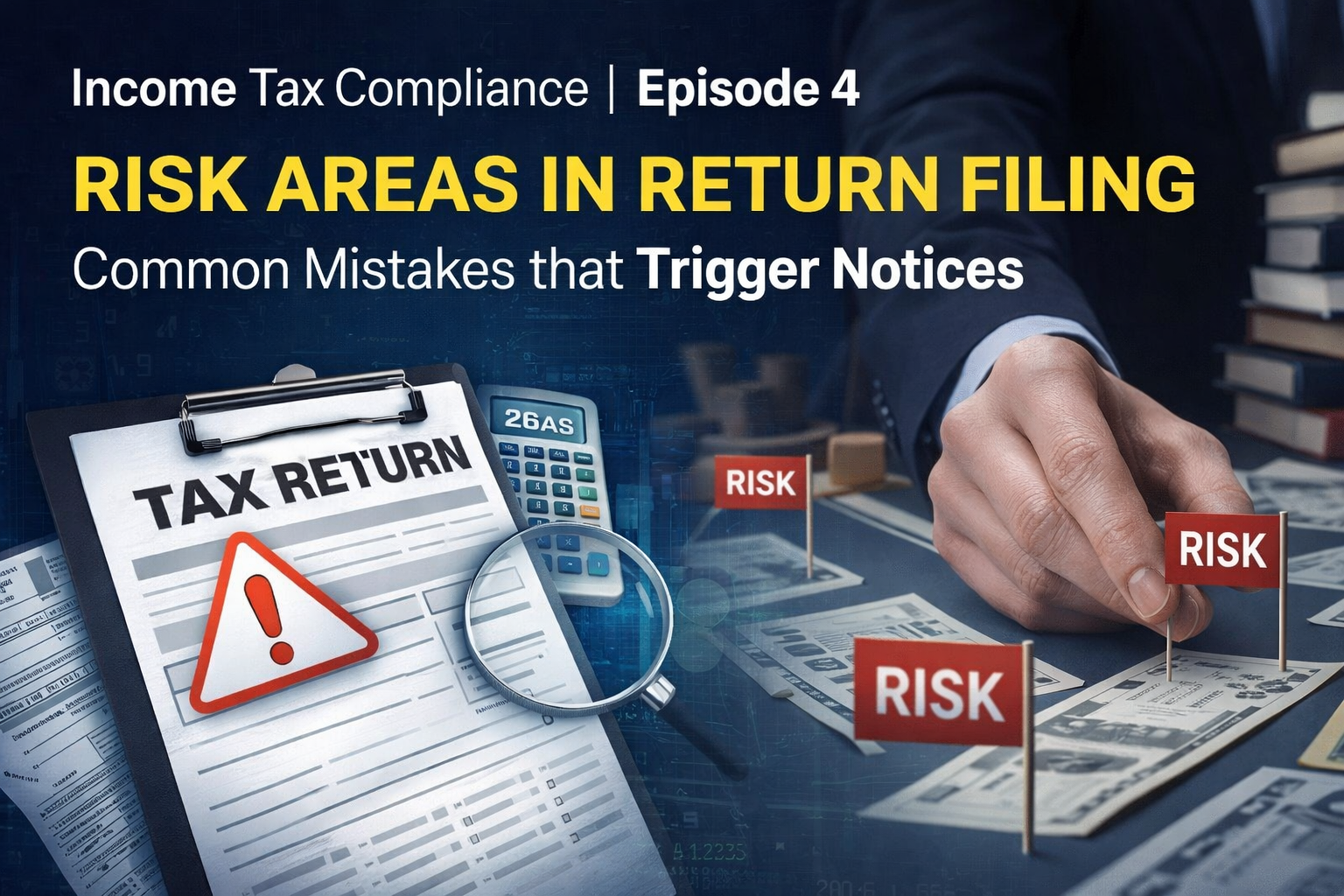
Risk Areas in Income Tax Return Filing: Common Mistakes That Trigger Notices

Introduction
Filing an Income Tax Return (ITR) is not merely a compliance formality. It is a legal declaration of income, deductions, tax liability, and financial disclosures.
In the current data-driven tax administration system, returns are processed through automated verification tools, data matching mechanisms, and risk assessment algorithms. Even minor inconsistencies may lead to notices, reassessment proceedings, or additional tax demands.
This article explains the key risk areas in return filing that commonly trigger scrutiny and departmental communication.
Watch the Complete Video Explanation
This Topic has also been explained in detail in the video below. Watch for practical clarity and structured understanding.
1. Mismatch Between ITR and AIS / Form 26AS
The Income Tax Department relies heavily on third-party data reporting through:
- Annual Information Statement (AIS)
- Form 26AS
- TDS returns filed by deductors
- High-value transaction reporting
If the income reported in the ITR does not match AIS or 26AS, the system flags the discrepancy.
Common examples:
- Interest income not disclosed
- Capital gains omitted
- TDS claimed without corresponding reporting
- Professional receipts under-reported
Even unintentional omissions may trigger automated notices.
2. Incorrect Claim of Deductions and Exemptions
Deductions under Chapter VI-A (such as 80C, 80D, 80G) and exemptions must be supported by proper documentation.
Risk arises when:
- Excess deduction is claimed
- Ineligible exemptions are taken
- Evidence is unavailable during verification
The system may issue intimation for adjustment or initiate further verification
3. Capital Gains Reporting Errors
Capital gains are among the most sensitive reporting areas.
Risk factors include:
- Non-reporting of property transactions
- Incorrect cost of acquisition
- Improper indexation
- Failure to report share or mutual fund transactions
Since property transactions are reported through stamp authorities and securities transactions through exchanges, mismatches are easily detected.
4. Business Income Underreporting
For professionals and businesses:
- Turnover mismatch with GST returns
- Non-disclosure of digital receipts
- Incorrect profit declaration under presumptive taxation
- High expense claims without justification
Data cross-verification between GST and Income Tax is increasingly common.
5. Incorrect Selection of ITR Form
Using the wrong ITR form may result in:
- Defective return notice
- Invalidation of filing
- Delayed processing
Each ITR form is structured for specific categories of income and taxpayers.
6. High-Risk Financial Transactions
Certain financial activities increase scrutiny probability:
- Large cash deposits
- High-value property purchases
- Foreign remittances
- Share trading with substantial turnover
- Significant loans and advances
These are captured through reporting systems and evaluated against declared income.
7. Failure to Disclose Foreign Assets or Income
Non-disclosure of foreign bank accounts, foreign assets, or overseas income carries severe consequences, including penalty and prosecution in extreme cases.
Transparency is critical in global reporting compliance.
8. Non-Compliance With Notices or Intimations
Ignoring initial communications such as:
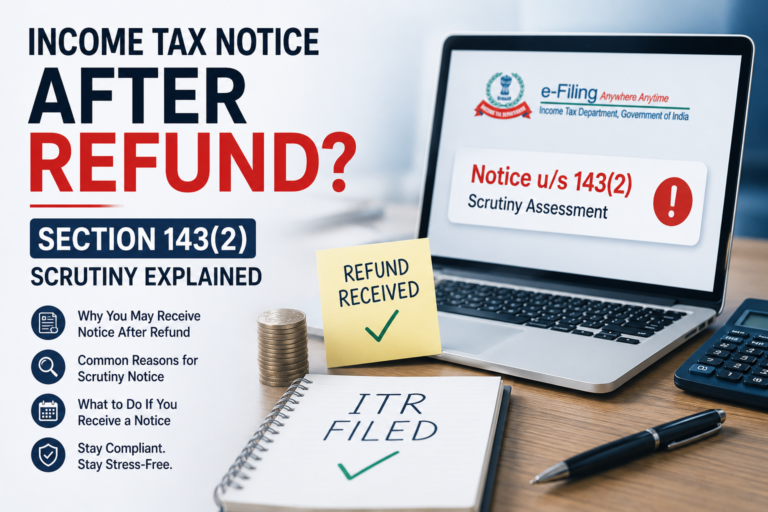
- Intimation under Section 143(1)
- Notice seeking clarification
- Defective return notice
may escalate the matter into reassessment proceedings.
Early response reduces litigation risk.
Practical Compliance Strategy
To minimize risk:
- Reconcile AIS and 26AS before filing
- Maintain supporting documents
- Cross-check GST turnover (if applicable)
- Review capital gains statements carefully
- Select correct ITR form
- Respond promptly to any communication
Conclusion
Income Tax Return filing is not a mechanical process. It is the foundation of the entire compliance cycle.
In a system driven by automated data verification and cross-matching, accuracy, transparency, and documentation discipline are essential.
Understanding risk areas helps taxpayers avoid unnecessary notices and litigation.