Mantra & Co. - Advocate & Tax Consultant

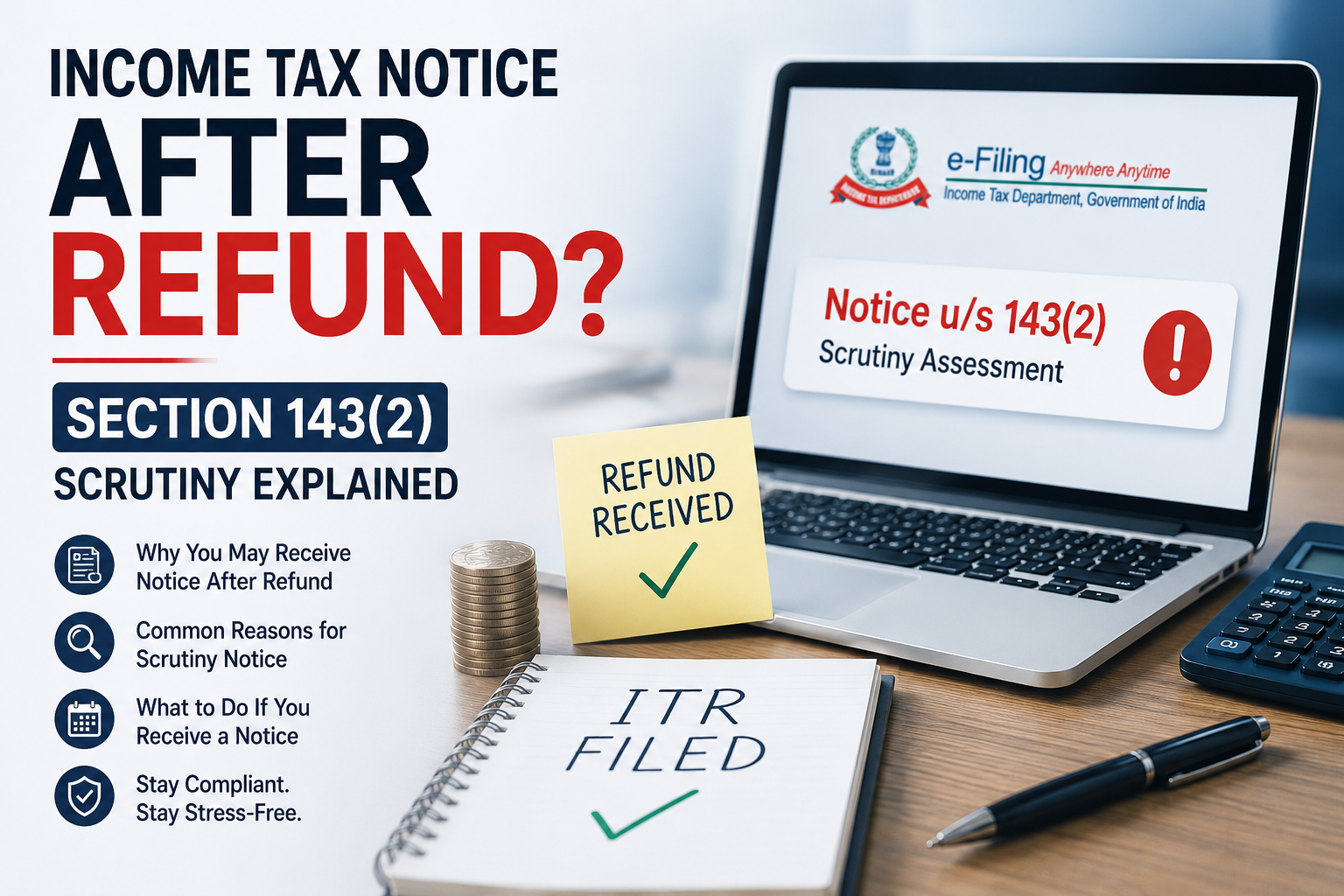
Income Tax Notice After Refund: Can You Get a Section 143(2) Notice?

Getting an Income Tax refund can make taxpayers feel that their ITR filing process is finally over. But what happens if an Income Tax notice arrives after the refund has already been credited to your bank account?
This situation can understandably create confusion.
Many taxpayers assume that once their refund is received, the Income Tax Department has completely accepted everything reported in the return. However, processing of an ITR and scrutiny of an ITR are different stages of the tax administration process.
Under applicable provisions of the Income-tax Act, a taxpayer may receive further communication from the Department even after the return has been processed or a refund has been issued.
One important communication taxpayers should understand is a notice under Section 143(2) in connection with scrutiny assessment.
This article explains what an Income Tax notice after a refund can mean, why questions may arise, what Section 143(2) is, and how taxpayers should approach such communications.
Disclaimer: This article is for general educational and informational purposes only. Tax provisions, procedures, timelines and applicability may vary depending on the assessment year and individual circumstances. This article should not be considered legal or tax advice for any specific case
Watch the Complete Video Explanation
for a better understanding of this topic, you can also refer to the detailed video explanation where the concepts are discussed step-by-step with practical insights and real-world context.
Can You Get an Income Tax Notice After Receiving a Refund?
Yes, a taxpayer may receive a subsequent statutory communication even after an ITR has been processed and a refund has been issued, subject to the applicable provisions and prescribed procedures.
This is one of the most important points taxpayers should understand.
An ITR going through processing does not necessarily mean that every aspect of the return has been examined in detail.
For example, a return may contain:
- Salary income
- HRA-related exemption
- Chapter VI-A deductions
- Interest income
- Capital gains
- Investment-related information
- Tax credits
- Other financial information
The Department may have information from different sources that can subsequently be relevant to verification or scrutiny, depending on the circumstances.
Therefore:
Refund received ≠ permanent immunity from future tax proceedings.
At the same time, receiving an Income Tax notice does not automatically mean that the taxpayer has done something wrong.
The nature and purpose of the notice need to be understood first.
What Is a Section 143(2) Income Tax Notice?
A Section 143(2) notice is associated with scrutiny assessment proceedings.
Broadly, scrutiny involves examination of a return and relevant information by the Income Tax Department in accordance with the applicable provisions and procedure.
The Department may seek clarification or supporting information regarding particular aspects of the return.
Depending on the circumstances, questions may relate to matters such as:
- Income reported
- Deductions claimed
- Exemptions claimed
- Tax credits
- Financial transactions
- Information available with the Department
- Supporting documentation
- Other matters relevant to the assessment
A Section 143(2) notice should therefore not be treated as an automatic finding of tax evasion or wrongdoing. It is important to read the actual notice and understand what has been selected for verification
Why Can an Income Tax Notice Come After a Refund?
One reason taxpayers can become concerned is that the refund may have already reached their bank account.
The important distinction is between return processing and subsequent scrutiny or verification.
Tax information can be available from multiple reporting sources. For example, taxpayers may see information relating to their financial activities through systems such as:
- Form 26AS
- Annual Information Statement (AIS)
- Taxpayer Information Summary (TIS)
- Form 16
- Bank-related information
- Investment-related information
- Property-related information
- Other information reported to the tax authorities
If information requires clarification or appears inconsistent with the taxpayer’s return, the matter may require further examination depending on the applicable provisions and circumstances.
Common Reasons Why an ITR May Require Further Verification
There is no single reason why a taxpayer may receive a scrutiny communication. Each case depends on its specific facts.
However, taxpayers should be particularly careful about the following areas while preparing and reviewing their ITR.
1. Incorrect Deduction Claims
Taxpayers sometimes claim deductions without checking whether they satisfy all the conditions applicable to that deduction.
A deduction should be claimed only when the taxpayer is eligible under the relevant provision and has appropriate supporting records wherever required.
2. Incorrect Tax Regime Selection
The tax regime selected while filing an ITR can significantly affect the availability of deductions and exemptions.
Certain deductions and exemptions available under the old tax regime may not be available in the same manner under the new tax regime, subject to the applicable provisions.
Therefore, taxpayers should not simply copy deductions from a previous year’s return.
The applicable rules should be checked for the relevant assessment year.
3. HRA Exemption Issues
HRA is another area where proper documentation and eligibility are important.
Depending on the facts, relevant records may include:
- Rent receipts
- Rent agreement
- Landlord details
- Evidence of rent payment
- Salary details
- Other relevant supporting documents
A taxpayer should ensure that the exemption claimed corresponds with the actual circumstances and applicable provisions.
4. Unsupported Investment Deductions
Taxpayers may claim deductions relating to eligible investments or payments without properly retaining supporting documents.
For example, where applicable, records relating to:
- Life insurance
- PPF
- ELSS
- Eligible tuition fees
- Other qualifying investments or payments
should be retained as appropriate.
The fact that a particular deduction was claimed in an earlier year does not automatically establish eligibility for the current year.
5. Interest Income Not Properly Considered
Interest income is another area that taxpayers sometimes overlook.
Savings account interest, fixed deposit interest and other interest income may need to be considered while preparing the return.
Taxpayers should review their financial records and relevant tax statements rather than relying only on their salary information or Form 16.
AIS and TIS Mismatch: Why Does It Matter?
The Annual Information Statement (AIS) provides taxpayers with information relating to various financial transactions and other information reported to the Income Tax Department.
The Taxpayer Information Summary (TIS) provides a summarized view of certain information available in the AIS.
Taxpayers should review these statements before filing their ITR and compare relevant information with their actual records.
However, an AIS entry should not automatically be treated as conclusive proof that the underlying transaction is taxable or that the information is necessarily correct.
There can be:
- Duplicate entries
- Incorrect reporting
- Timing differences
- Transactions requiring clarification
- Information reported under incorrect details
Therefore, the right approach is verification and reconciliation, rather than simply assuming that every AIS entry is correct.
Can High-Value Transactions Lead to Questions?
Certain financial transactions may require additional attention where the available information does not appear consistent with the taxpayer’s reported financial information.
Examples may include:
- Property transactions
- Significant investments
- Securities transactions
- Mutual fund transactions
- Certain banking transactions
- Other reportable financial activities
However, a high-value transaction is not automatically an indication of tax evasion or an incorrect return.
The source of funds, nature of the transaction, documentation and tax treatment all matter.
For this reason, taxpayers should maintain appropriate records for significant financial transactions.
What Should You Do If You Receive an Income Tax Scrutiny Notice?
The first and most important step is:
Don’t panic — and don’t ignore it.
A notice should be evaluated based on what the Department has actually asked.
Step 1: Verify the Communication
Log in to the official Income Tax e-filing portal and review the communication.
Check:
- Assessment Year
- Notice type
- Notice date
- Reference/document number
- Issues mentioned
- Information requested
Response deadline
Step 2: Review Your Filed ITR
Compare the notice with your original return.
Look specifically at:
- Income
- Exemptions
- Deductions
- Tax credits
- Investments
- Interest income
- Capital gains
- Other relevant disclosures
Step 3: Collect Supporting Documents
Depending on the issue, documents may include:
- Form 16
- Form 26AS
- AIS/TIS
- Bank statements
- Investment statements
- Rent receipts
- Relevant agreements
- Investment proofs
- Tax computation
- Other supporting records
The documents required will depend on the specific issue mentioned in the notice.
Step 4: Reconcile the Information
If there is a mismatch, determine why it exists.
For example, the difference could arise because:
- A transaction was reported incorrectly by a third party.
- The same transaction appears more than once.
- The transaction relates to another person.
- There is a timing difference.
- Income was inadvertently omitted.
- A deduction or exemption was incorrectly claimed.
Understanding the actual reason is important before preparing a response.
Step 5: Respond Within the Applicable Timeline
If a response is required, taxpayers should comply with the timeline mentioned in the communication and use the prescribed procedure.
Ignoring a statutory communication can potentially create additional complications.
Where the matter involves significant tax implications or complex issues, taxpayers may consider seeking professional assistance.
For taxpayers looking for Income Tax compliance and advisory support, professional assistance can help in reviewing the notice, understanding the issue and preparing a fact-based response.
What Happens If an Income Tax Notice Is Ignored?
The consequences depend on the type of communication, the proceedings involved and the taxpayer’s specific circumstances.
Ignoring a statutory communication may result in the Department proceeding further based on the information available to it, subject to the applicable law and procedure.
Depending on the case, this could potentially involve:
- Disallowance of an unsupported claim
- Additional tax liability
- Interest consequences where applicable
- Further proceedings
- Penalty proceedings where the relevant statutory conditions are satisfied
However, penalty or additional tax is not automatically imposed simply because a taxpayer receives a scrutiny notice.
The actual outcome depends on the facts and applicable provisions.
What Happens to the Refund Already Received?
This is usually the biggest concern for taxpayers.
If scrutiny results in a determination that additional tax is payable, the tax consequences will depend on the assessment and applicable provisions.
A refund that has already been received does not necessarily prevent a subsequent tax demand from arising if the assessment ultimately determines that additional tax is payable.
This is why taxpayers should not treat a refund as an assurance that every claim in the ITR has been permanently accepted.
At the same time, a notice does not mean that the taxpayer will necessarily have to repay the entire refund.
The result depends on what is examined, what is established through the proceedings and the applicable law.
How Can You Reduce the Risk of ITR-Related Problems?
While no taxpayer can guarantee that they will never receive a notice, careful tax compliance can reduce avoidable mistakes.
Before filing your ITR:
✔ Verify your income
Make sure salary, interest, capital gains and other relevant income are appropriately considered.
✔ Review Form 16 and Form 26AS
Check whether the TDS information corresponds with your records.
✔ Check AIS and TIS
Review reported transactions and investigate significant discrepancies.
✔ Verify deductions
Claim deductions only when you meet the applicable conditions.
✔ Maintain supporting documents
Keep appropriate records supporting exemptions, deductions and other disclosures.
✔ Review the selected tax regime
Understand which deductions and exemptions are available under the applicable regime.
✔ Reconcile before filing
A few minutes spent checking your information before filing can help identify errors before they become compliance issues.
For taxpayers who need assistance with return preparation and compliance, you can explore our Income Tax Services and related tax advisory services.
Income Tax Notice After Refund: The Key Takeaway
Receiving an Income Tax refund can be a positive outcome, but taxpayers should understand that refund processing and scrutiny are not necessarily the same thing.
A taxpayer may receive a subsequent statutory communication where the applicable provisions permit further examination.
If you receive a Section 143(2) scrutiny notice, don’t immediately assume that you have committed an offence or that your entire ITR is incorrect.
Instead:
Read the notice → Understand the issue → Check your ITR → Reconcile your records → Collect supporting documents → Respond within the applicable timeline.
The most important thing is to deal with the communication based on facts and applicable tax provisions.
For assistance with ITR filing, Income Tax compliance, tax advisory and handling of Income Tax-related communications, taxpayers may consider taking professional assistance based on their individual circumstances.
Frequently Asked Questions About Income Tax Notice After Refund
1. Can I receive an Income Tax notice after getting my refund?
Yes. Receiving a refund does not necessarily prevent subsequent statutory communication or proceedings where permitted under the applicable provisions.
2. What does Section 143(2) mean?
Section 143(2) relates to scrutiny assessment proceedings under the Income-tax Act. The notice generally indicates that the return is being selected for scrutiny or verification in accordance with the applicable procedure.
3. Does a Section 143(2) notice mean that my ITR is wrong?
Not necessarily. A scrutiny notice does not by itself establish that the taxpayer has made an incorrect claim or deliberately concealed income.
4. Can the Income Tax Department ask questions about HRA?
Depending on the circumstances, HRA-related claims may require verification of eligibility and supporting information.
5. Can an AIS mismatch cause an Income Tax notice?
An AIS discrepancy can be relevant to tax verification, but a mismatch does not automatically mean that the taxpayer has made an incorrect claim. The underlying transaction should be checked and reconciled.
6. What happens if I don’t respond to an Income Tax notice?
The consequences depend on the type of notice and applicable proceedings. Ignoring a statutory communication can potentially lead to further proceedings or other consequences, so the notice should be reviewed carefully and dealt with within the applicable timeline.
7. Will I automatically have to return my refund if I receive a scrutiny notice?
No. Receiving a scrutiny notice does not automatically mean that the entire refund must be repaid. Any resulting tax liability depends on the outcome of the proceedings and applicable provisions.
8. How can I check whether I have received an Income Tax notice? Taxpayers can log in to the official Income Tax e-filing portal and check their available communications, notices and e-Proceedings, as applicable.