Mantra & Co. - Advocate & Tax Consultant

Stay of Demand Under Income Tax: Understanding Interim Relief During Tax Appeal

Introduction
Receiving a tax demand from the Income Tax Department can create immediate financial stress for taxpayers, especially when they believe the demand is incorrect and have already decided to challenge it.
A common question in such situations is:
Watch the Complete Video Explanation
This topic has also been explained in detail through our video session. Watch the complete explanation to understand how internships and professional courses work together to build practical expertise in accounting and taxation
Do you have to pay the entire tax demand immediately even after filing an appeal?
The answer depends on the facts of the case.
Under the Income Tax framework, taxpayers may seek Stay of Demand under Income Tax, which can provide temporary protection from recovery proceedings while the appeal is pending.
Understanding how stay applications and interim relief work is important for taxpayers, business owners, and professionals dealing with tax disputes.
What is Stay of Demand Under Income Tax?
The Stay of Demand under Income Tax means that the tax demand itself is not cancelled, but its recovery is temporarily suspended.
The basic process usually looks like this:
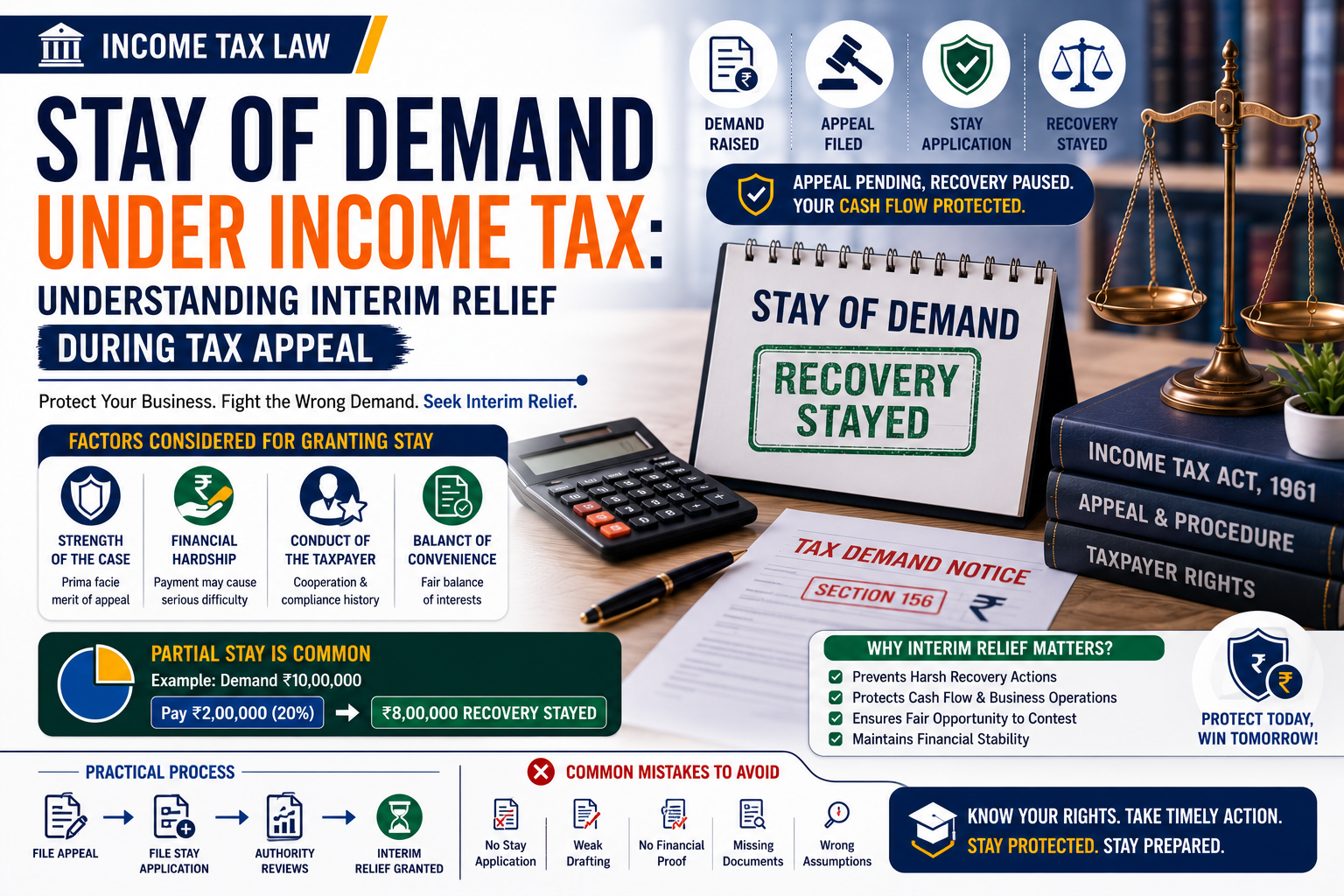
Demand Raised → Appeal Filed → Stay Application → Temporary Relief from Recovery
This distinction is important.
A stay does not mean the liability is removed.
It only means the department may pause recovery action until the dispute is decided. This acts as an important procedural safeguard in tax litigation.
Understanding the Concept with a Practical Example
Suppose a taxpayer receives an additional tax demand of ₹10 lakh after assessment.
The taxpayer believes the addition is incorrect and files an appeal before the Commissioner of Income Tax (Appeals).
Along with the appeal, the taxpayer may file a stay application.
If the authority finds merit, it may decide:
“Recovery of demand will remain on hold temporarily.”
This allows the taxpayer to contest the case without immediate recovery pressure.
Why is Stay of Demand Important?
A stay application can be an important financial protection mechanism.
Without a stay, the department may begin recovery proceedings even if the appeal is pending.
Possible recovery actions may include:
- Bank account attachment
- Adjustment of income tax refunds
- Recovery notices
- Property attachment in certain cases
- Garnishee proceedings against debtors
This can affect business liquidity, cash flow, and financial planning.
That is why timely action becomes important.
Is Stay of Demand Automatic?
No.
One of the biggest misconceptions is that filing an appeal automatically stops recovery.
That is not correct.
Stay of Demand under Income Tax is not an automatic right.
The authority examines the facts and decides whether temporary protection should be granted.
This makes proper drafting and factual presentation very important.
Factors Considered While Granting Stay of Demand
While deciding a stay application, authorities usually consider several factors.
1. Strength of the Case
The authority may review whether the taxpayer has a strong prima facie case.
For example:
- Wrong addition by the Assessing Officer
- Incorrect interpretation of law
- Ignoring valid evidence
A stronger case may improve the chances of stay.
2. Financial Hardship
If immediate payment creates serious financial difficulty, this may be considered.
For example:
- Cash flow issues in business
- Working capital blockage
- Operational challenges
This factor is often relevant for small and medium businesses.
3. Conduct of the Taxpayer
The taxpayer’s overall conduct is also important.
Authorities may check:
- Whether the taxpayer has cooperated during assessment
- Whether records were properly maintained
- Whether there is genuine intention to comply
Good conduct can support the stay application.
What is Partial Stay of Demand?
In many cases, authorities may not grant full stay.
Instead, they may allow partial stay.
For example:
Tax Demand: ₹10 lakh
Condition: Pay ₹2 lakh (20%)
Remaining ₹8 lakh: Recovery stayed temporarily
This practice is common in many cases.
It balances the department’s interest with the taxpayer’s protection.
What is Interim Relief in Tax Appeals?
Interim Relief refers to temporary protection granted during the pendency of an appeal.
Its objective is simple:
To prevent recovery action until the matter is heard and decided.
This ensures that taxpayers are not forced into financial hardship before the legal dispute is resolved.
Interim relief is often sought where immediate recovery may cause disproportionate damage.
Practical Strategy for Filing a Stay Application
A properly drafted stay application should clearly explain:
- Why the demand is disputed
- Why the case has legal merit
- Why recovery should be paused
- What financial hardship may arise
- Relevant supporting documents
Practical Insight:
A vague or incomplete stay application can reduce the effectiveness of the request.
A structured application with facts, law, and evidence usually creates better clarity.
Common Mistakes in Stay Applications
Taxpayers often make avoidable mistakes while seeking interim relief.
| Mistake | Issue Created | Possible Impact |
| Filing appeal without stay application | Recovery may continue | Financial pressure increases |
| Weak drafting | Lack of clarity | Lower chance of relief |
| No financial proof | Hardship not established | Stay may be rejected |
| Missing documents | Incomplete case presentation | Delays and procedural issues |
| Assuming appeal stops recovery automatically | Wrong assumption | Unexpected recovery action |
Understanding these practical risks can help taxpayers prepare better
Conclusion
The Stay of Demand under Income Tax is an important safeguard for taxpayers facing disputed tax demands. It provides temporary protection against recovery while the appeal process continues.
However, it is important to understand that stay is not automatic. It depends on facts, legal strength, financial circumstances, and procedural compliance.
Knowing how interim relief works can help taxpayers make informed decisions and protect their financial position while pursuing their legal remedies.
Tax law is not only about liabilities—it also includes rights and procedural protections.
Disclaimer
This article is for educational purposes only and should not be considered legal or tax advice.