Mantra & Co. - Advocate & Tax Consultant

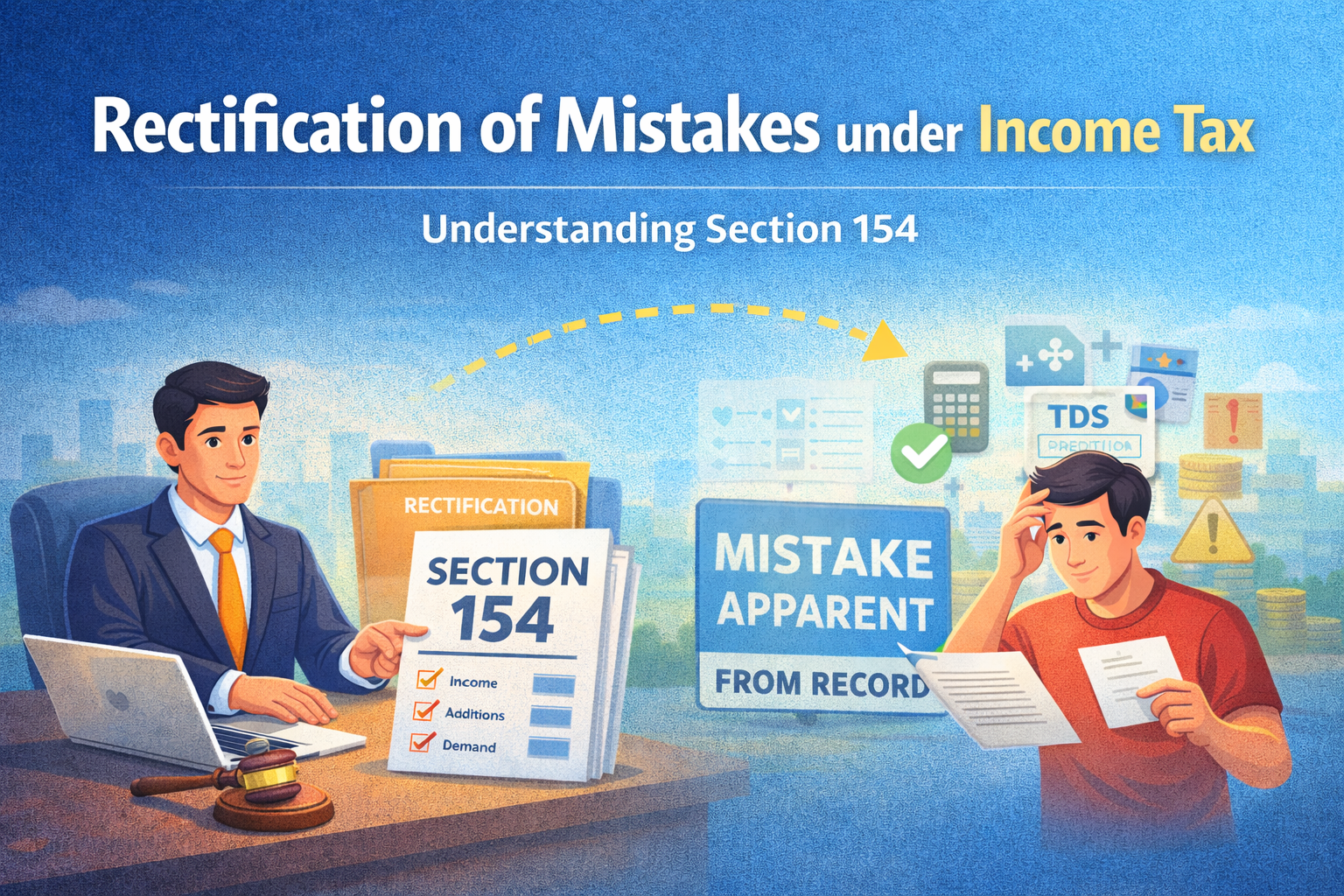
Rectification of Mistakes under Income Tax – Understanding Section 154

Introduction
In the process of tax administration, errors may sometimes occur either on the part of the taxpayer or the tax authorities. These mistakes may arise due to incorrect calculations, mismatch of information, or clerical errors in the assessment order.
To address such situations, the Income Tax Act provides a legal remedy through rectification of mistakes under Section 154.
Rectification allows the tax authorities to correct errors that are apparent from the record without initiating lengthy litigation or appeal proceedings.
This article explains the concept of rectification, the types of mistakes that can be corrected, and the practical procedure for filing a rectification request.
Watch the Complete Video Explanation
This topic has also been explained in detail in the video below. Watch for practical clarity and structured understanding
What is Rectification under Section 154?
Rectification refers to the correction of an obvious mistake appearing in the record.
The objective of rectification is to ensure that simple and clear errors can be corrected quickly without the need for formal litigation.
However, rectification is permitted only when the mistake is apparent from the record and does not require detailed interpretation of law.
What is a “Mistake Apparent from Record”?
A mistake apparent from the record refers to an error that is clear, obvious, and not subject to debate.
Examples include:
• mathematical errors
• incorrect calculation of tax
• mismatch of TDS credit
• incorrect carry forward of losses
• clerical errors in the assessment order
Such mistakes can be corrected through rectification.
However, issues involving interpretation of law or disputed facts cannot be resolved through rectification.
Who Can Initiate Rectification?
Rectification may be initiated by:
- the taxpayer
- the Assessing Officer
- the tax authority on its own motion
Taxpayers typically file rectification applications through the Income Tax e-filing portal.
Time Limit for Rectification
Under the Income Tax Act, rectification can generally be carried out within four years from the end of the financial year in which the order was passed.
This time limit ensures that errors are corrected within a reasonable period.
Rectification vs Appeal
It is important to distinguish between rectification and appeal.
Rectification is suitable when:
• the error is obvious
• the issue is purely clerical or computational
Appeal is required when:
• the dispute involves interpretation of law
• the taxpayer disagrees with additions made by the department
Thus, rectification serves as a quick correction mechanism, while appeals deal with substantive disputes.
Practical Example
Suppose a taxpayer claimed TDS of ₹1,00,000 in the return.
However, while processing the return, the CPC allowed only ₹70,000 due to mismatch.
If the taxpayer possesses valid TDS evidence, a rectification request can be filed to correct the mistake.
After verification, the department may revise the demand or issue the correct refund.
Conclusion
Rectification under Section 154 is an important provision that enables taxpayers and tax authorities to correct apparent errors without initiating complex legal proceedings.
Understanding the scope and limitations of rectification helps taxpayers address simple mistakes efficiently and avoid unnecessary litigation.
For professionals and taxpayers alike, awareness of rectification provisions ensures that minor errors do not escalate into major disputes.
Tax ko samajhna mushkil nahi hai,
system ko samajhna zaroori hai.
Disclaimer: This article is for informational purposes only and does not constitute legal or tax advice. The views expressed are based on the current understanding of law and portal functionality as on the date of publication. Readers are advised to seek professional advice before taking any action.
If you have any general query or wish to understand the subject better, you may share your question in the comments below.